
New Combination Therapy for Anal Cancer: Isolated Hypoxic Pelvic Perfusion with Electroporation Leads to Complete Remission


A new, gentler combination therapy for the treatment of anal cancer has been developed at the Medias Clinic, which has shown encouraging results in a clinical case series. The aim of this method is to treat the tumors in a targeted manner with minimal side effects. The therapy combines isolated hypoxic pelvic perfusion (HPP) with reversible electroporation and led to complete tumor remission in all four treated patients. The remarkable aspect: Even recurrences after unsuccessful radiochemotherapy could be treated in an organ-preserving manner.
Squamous cell carcinoma of the anus affects about 2,500 people each year in Germany and represents approximately two percent of all gastrointestinal tumors. Although standard radiochemotherapy achieves good remission rates in many cases, it can also cause significant side effects, such as mucosal inflammation and skin reactions. Moreover, in cases of relapse, surgery, which often results in a permanent colostomy, may be the only remaining option.
Precise Drug Delivery Through Isolated Perfusion & Electroporation
T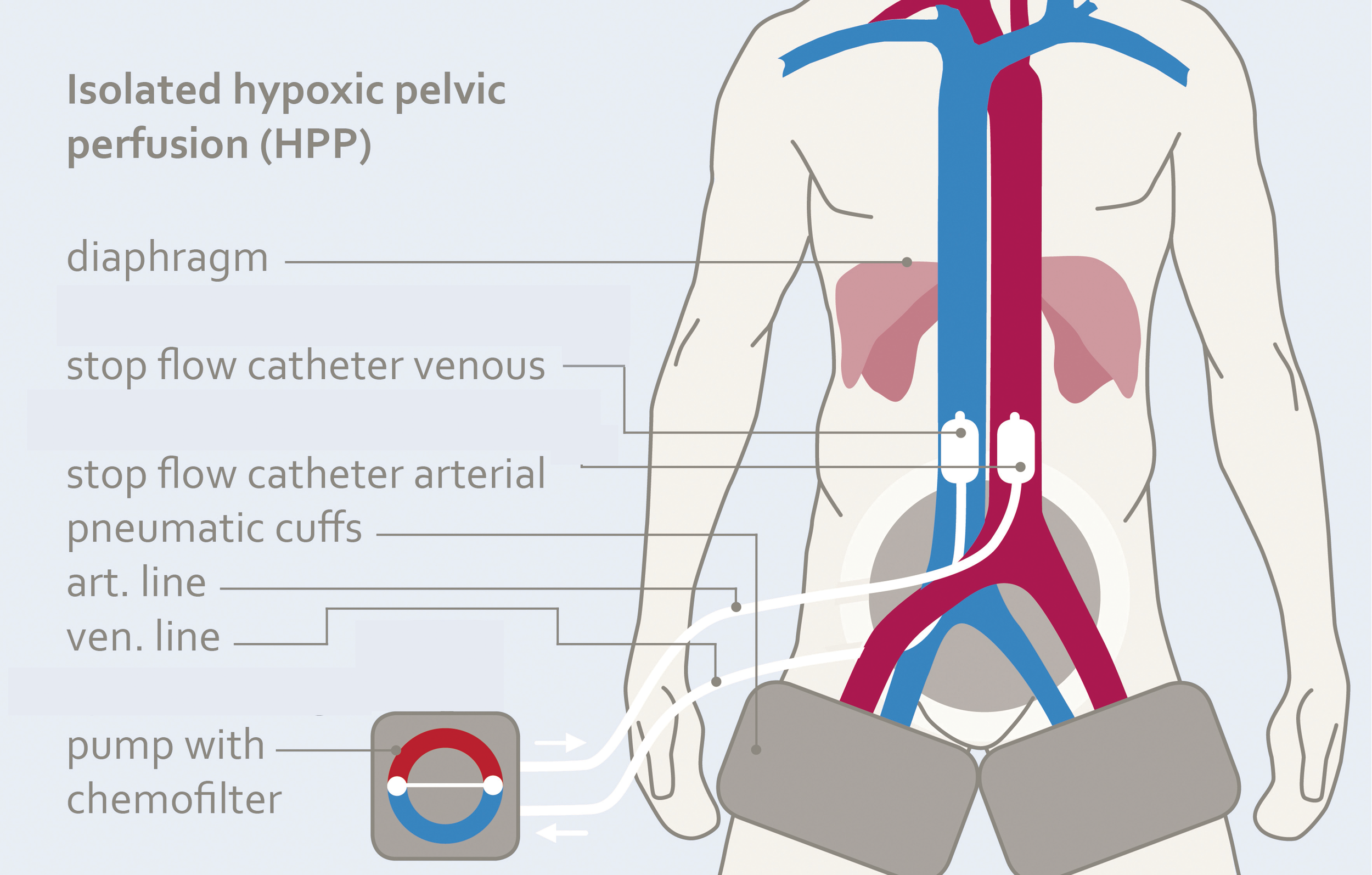 he two-stage procedure developed at Medias Clinic first isolates the blood supply to the pelvis from the general circulatory system using strategically placed stop-flow balloon catheters. Chemotherapy is then delivered directly to the tumor region via these catheters in rhythmic pulses. The five-minute interruption of normal blood flow results in hypoxic perfusion of the pelvis. This allows for extremely high drug concentrations to be achieved in the tumor area, which would not be possible with conventional therapy.
Additionally, reversible electroporation is used: short electrical pulses are delivered via specially placed electrodes, temporarily making tumor cells more permeable to chemotherapeutic agents. The drugs are precisely administered during these electrical pulses, allowing them to penetrate cancer cells even more effectively. Subsequent chemofiltration removes excess cytostatic drugs from the blood, thus minimizing systemic side effects for the patients.
Complete Remission in All Treated Patients
The effectiveness of this innovative method was demonstrated in a clinical case series. The medical team led by Prof. Dr. Karl R. Aigner, chief physician and medical director at the Medias Clinic, treated four patients with HPV-positive anal cancer: Two initially untreated G3 carcinomas (poorly differentiated, aggressive tumors) received isolated pelvic perfusion and achieved complete remission after two to three cycles.
Clinical-histological remission. Two recurrent G2 carcinomas (moderately differentiated tumors) after unsuccessful radiochemotherapy were treated with a combination of isolated pelvic perfusion and electroporation (electrochemotherapy) and also achieved complete tumor regression.
The documented disease-free intervals were 8, 10, 27, and 48 months. The therapy did not cause any serious hematological, gastrointestinal, or dermatological toxicities, and there was no therapy-related impairment of quality of life. This stands in stark contrast to conventional radiochemotherapy, which has a 5-year survival rate of 65-79 % and is sometimes associated with significant long-term effects.
Applications and Outlook
The case series suggests that the new combination therapy could represent an effective and, at the same time, gentler alternative to established radiochemotherapy for anal cancer. The method is particularly relevant for patients with primary, locally advanced tumors, therapy-resistant carcinomas, or local recurrences, for whom surgery with a permanent colostomy was often the only option until now.
Despite the small cohort, the results are very encouraging. The case series is currently being continued,” explains Prof. Dr. Karl R. Aigner, medical sirector and chief doctor at Medias Clinic, Germany. “The crucial point for us is that we can offer patients an organ-preserving alternative that causes hardly any side effects. This is a major difference compared to conventional radiochemotherapy, where about half of the patients have to interrupt treatment due to severe side effects."
Isolated hypoxic pelvic perfusion combined with electroporation allows for high local drug exposure with minimal systemic toxicity. However, further prospective studies with larger patient numbers are needed to evaluate the efficacy and safety of this method compared to established radiochemotherapy.
Further information on the study can be found here: Aigner, K.; Hendrikx, MJH; Bekrentchir, A.; Aust, H. Isolated hypoxic pelvic perfusion combined with electroporation is a valid alternative to traditional therapies for anal squamous cell carcinoma: a case study. Front. Oncol. 2025, 15, 1644317. doi: 10.3389/fonc.2025.1644317